French Nasal Vowels with Songs: A 12-Minute Pronunciation Drill
7 min read58 views
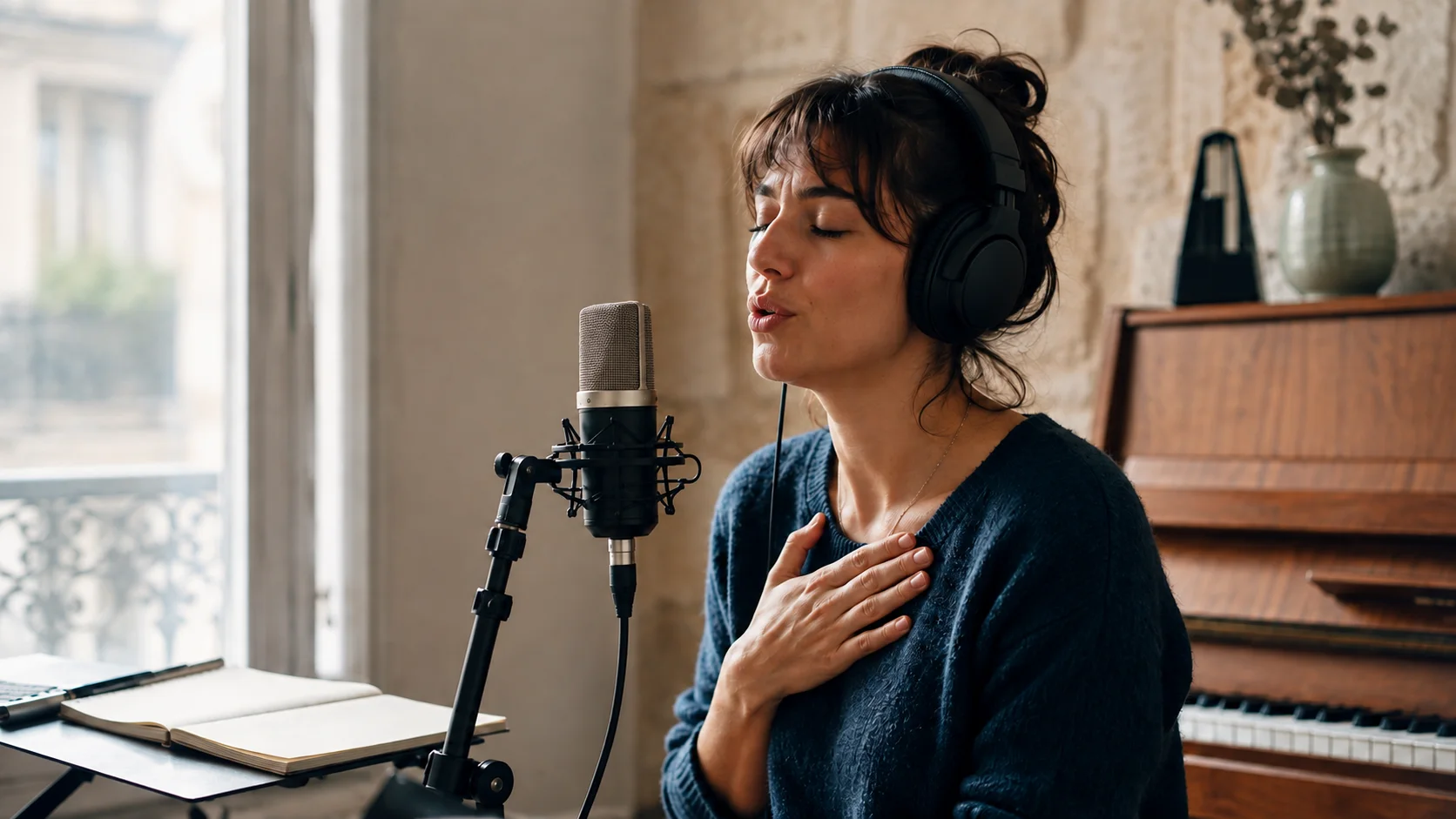
French nasal vowels can make familiar words disappear inside a song. You may know sans, pain, son and un on the page, yet hear only a blur when a singer connects them to the next phrase. The solution is not to repeat an entire playlist. It is to train one contrast at a time inside a line you genuinely want to replay.
A nasal vowel is still a vowel: you sustain it without finishing on a strong n or m sound. The soft palate lowers so resonance is shared between the mouth and nose. Keep the jaw and tongue relaxed, let the sound remain open, and avoid squeezing the throat or forcing air through the nose. Clear contrast matters more than exaggerated nasality.
Traditional descriptions distinguish four French nasal vowels. You can anchor them with sans /ɑ̃/, vin /ɛ̃/, son /ɔ̃/ and un /œ̃/. Many contemporary speakers merge the vowel in un with the vowel in vin, while other accents keep them distinct. Treat that variation as normal: your first goal is to recognise the words and produce a consistent, understandable contrast.
Spelling offers clues, not a perfect button. Combinations such as an or en, in or ain, on, and un often signal a nasal vowel when n or m closes the syllable. If another vowel follows, or the consonant is doubled, the vowel is commonly oral and the consonant is pronounced, as in bonne or année. Always trust the sound and the word, not a letter pair in isolation.
Before practising, hear the target inside real connected French. The French pronunciation and listening hub gives you a wider route through rhythm, liaison and sound boundaries; this drill then narrows the work to a single vowel family.
Choose a chorus or verse fragment lasting 8 to 15 seconds. It should contain two or three nasal-vowel words, clear enough vocals, and a melody you can comfortably sing in your own range. Read the karaoke lyric once and circle the likely spellings, but do not assume every n or m makes the previous vowel nasal.
Minutes 0–2 — Listen and map. Play the fragment three times without singing. On the first pass, follow the meaning. On the second, tap when you hear a nasal vowel. On the third, match each tap to a word in the lyric. If you are unsure, mark the word with a question mark rather than inventing certainty.
Minutes 2–4 — Isolate the vowel. Say the whole target word slowly, then hold only its vowel for one comfortable beat. Return immediately to the normal word so the exercise does not become an artificial accent. Alternate two anchors such as sans–son or pain–pont and notice the change in tongue position and lip shape as well as resonance.
Minutes 4–7 — Echo the singer. Replay one line, pause, and copy its rhythm at speaking volume. Repeat it once with the lyric and once without looking. Then shadow just behind the voice. Do not chase the singer's pitch if it creates tension; the pronunciation target is the vowel and its timing inside the phrase.
Minutes 7–9 — Build a contrast grid. Write the four anchors in separate columns and place each target word under the sound you hear. Replay only the uncertain words. If two columns keep collapsing together, practise that pair in short alternations, then put both words back into the original line.
Minutes 9–11 — Record one clean attempt on your phone. Compare three things, not your entire accent: did the vowel stay open, did you avoid adding a final n or m, and can you hear a difference from the neighbouring nasal vowel? Make one adjustment and record again. Two purposeful takes are more useful than twenty automatic repetitions.
Minutes 11–12 — Retrieve from memory. Hide the lyric, say the target words, and perform the line once with the backing track. Finish by naming the contrast that needs another session. That final decision turns a pleasant sing-along into a measurable pronunciation practice without making the song feel like a test.
Scale the material to your level. At A1–A2, work with two anchors and a slow repeated chorus. At B1, classify words across three vowel families and shadow a complete line. At B2 and above, compare how the sounds change in faster connected speech or across singers. The A2 French learning path helps you decide when simple recognition is ready to become active production.
Pronunciation practice becomes valuable when it supports a real interaction. Add one target phrase you could say while introducing yourself, ordering food or telling a short story, then use it in the next speaking session. The French conversation goal can connect this sound work to the moments when another person actually needs to understand you.
Repeat the same fragment on three non-consecutive days before changing songs. Day one is discovery, day two is cleaner contrast, and day three is recall without the lyric. Put those short returns into a realistic French study plan so the drill complements vocabulary and comprehension instead of replacing them.
LingoTunes makes the loop easy to repeat: choose an original French song matched to your level, listen before revealing the karaoke lyric, use the translation to confirm meaning, and let difficult words return through review. Start with one line and one contrast today. A clearer French sound system is built from small differences you can finally hear, reproduce and remember inside music.
Download LingoTunes
LingoTunes turns French vocabulary and grammar into original songs matched to your level.