French Dictation with Songs: A 15-Minute Routine to Train Your Ear
7 min read102 views
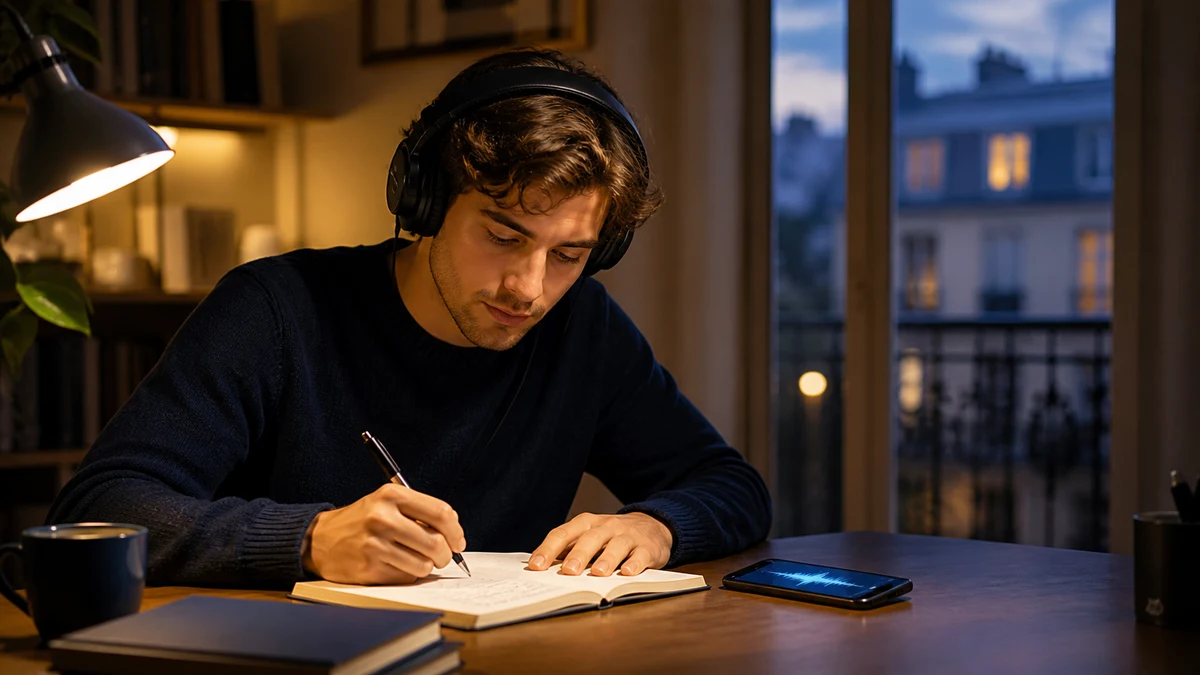
French dictation practice does not need a long recording or a school-style test. One short song passage is enough to expose the exact moment where familiar written French becomes difficult to hear. The useful work happens when you listen, make a precise guess, compare it with the lyric, and listen again with new information.
This is active listening rather than background listening. Writing forces you to decide where one word ends, whether a tiny pronoun was present, and which ending you actually heard. A song adds a stable rhythm and a reason to replay the same line, so repetition feels purposeful instead of mechanical.
Choose a passage that lasts about 10 to 20 seconds. It should contain one complete thought, have reasonably clear vocals, and sit close to your current level. If almost every word is unknown, move to an easier song; if you can transcribe it perfectly on the first listen, choose a slightly denser passage. The aim is a useful gap, not maximum difficulty.
Before you press play, decide when this short session will happen. Add it to a realistic French study plan instead of treating it as an extra task you must somehow fit in later. Fifteen focused minutes repeated several times a week will teach you more about your listening gaps than an occasional hour of half-attentive audio.
Minutes 0–2 — Listen for the whole message. Play the passage twice without writing. On the first listen, identify the situation and emotion. On the second, notice how many phrases you hear and where the voice seems to pause. Do not chase every syllable yet.
Minutes 2–5 — Build a rough transcript. Write the words you are confident about and leave visible blanks for the rest. Replay the complete passage rather than pausing after every word. Your first draft should show what your ear currently understands, including uncertainty.
Minutes 5–9 — Repair the blanks. Loop one line at a time and make no more than three serious attempts before checking. Say possible words aloud: French spelling becomes easier to predict when you connect the sound to a form your mouth can produce. Keep uncertain endings in brackets rather than silently guessing them away.
Minutes 9–12 — Compare with the karaoke lyric and translation. Mark only meaningful differences: a missing small word, a wrong sound boundary, an unknown expression, or a grammar ending you heard but could not spell. The translation is there to confirm the idea of the line; it should not replace the French transcript.
Minutes 12–15 — Listen again, then shadow the corrected line. Read once with the lyric, replay without looking, and repeat just behind the singer. Finish with one clean listen to the full passage. You should now hear details that were invisible three minutes earlier.
Use a four-symbol error log so your mistakes become a plan: S for a sound you could not distinguish, B for a word boundary you placed incorrectly, V for unknown vocabulary, and G for a grammar or spelling ending. After three sessions, count the symbols. The most common one tells you what to practise next.
Adjust the size, not the method, to your CEFR level. At A1–A2, transcribe four to eight words from a slow chorus. At B1, use one or two natural lines and keep contractions. At B2–C1, work with denser verses, reduced speech and implied meaning. The B1 learning path can help you judge when to move from isolated phrases to connected speech.
If S and B dominate your log, spend time in the French pronunciation and listening hub. Work on liaison, elision and recurring vowel contrasts, then return to the same song a few days later. Hearing a previously missed boundary without looking is a stronger sign of progress than merely remembering the answer.
A simple weekly rhythm is enough: two new passages, one return to an older passage, and one relaxed song session with no transcription. Keep the difficult lines in review, but do not turn an entire song into homework. Micro-dictation works because the target is small enough to examine closely and repeat consistently.
This routine also transfers to exam listening. You are practising attention to short functional words, sequence, tense and speaker intention—the details that can separate a plausible answer from the correct one. Before an exam, pair song practice with the task formats and scoring rules in the DELF preparation guide; music strengthens the listening habit, while exam materials teach the test itself.
Do not use the number of spelling mistakes as a verdict on your French level. Dictation combines listening, vocabulary, grammar and orthography, so one error can have several causes. Track which kind of error is becoming less frequent and whether you need fewer replays to understand the line.
LingoTunes gives this routine a practical loop: choose a French song matched to your level, listen first, reveal karaoke lyrics and translation only when you are ready to compare, then let difficult words return through review. Start with one 15-second passage today. The goal is not a flawless notebook page; it is to make tomorrow's French sound less blurred than today's.
Download LingoTunes
LingoTunes turns French vocabulary and grammar into original songs matched to your level.